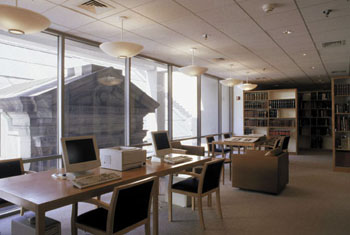
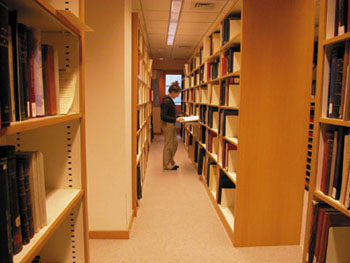
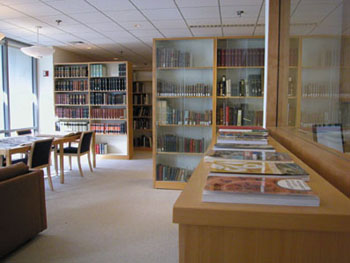
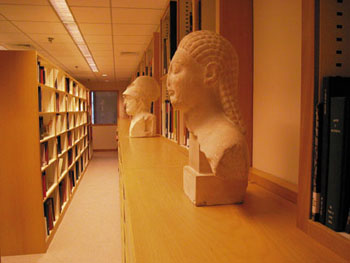
The Onassis Library for Greek and Roman Art at the Metropolitan Museum of Art
celebrated its sixth year of operations in October 2006.
In November 1996, in keeping with one of its basic founding goals, which is the
promotion of Greek culture to the global community, the Foundation decided to
finance the construction, equipment, and operation of a specialised library dedicated
to Greek-Roman art at the Metropolitan Museum of Art of New York. The 685 m²
library commenced operations in 2000 and has welcomed more than 8,000 visitors
since then.
The collection’s original core dates back to 1909 when the museum’s Department
of Classical Art was first created. It was significantly expanded in 1931 with
a donation of books and magazines made by the museum’s second director, Edward
Robinson. Over subsequent years, the collection was further enriched through
donations made by various lecturers and private individuals, and more recently
through a contribution made by a group of friends of the museum department named
“Filodori” (“gift givers”). This mass of books was kept in the old offices of
the Department of Greek and Roman Art until 2000 when the ultramodern library
building was opened. Through financing by the Onassis Foundation, an autonomous
library area was built at the museum featuring the appropriate infrastructure
and the necessary technological equipment to enable the on-line availability
of records. A new library, open to researchers from all corners of the planet,
was born.
As explained by Mark Santangelo, the Onassis Library
aims to comprise one of the main research centres
for the study of Greek-Roman art in the United
States. This ambitious vision is being achieved
with the help of a policy put forth by its management,
namely the gradual expansion of its collections.
Today, it hosts approximately twelve thousand specialised
volumes covering areas of ancient art and archaeology,
like sculpting, ceramics, glassworks, jewellery,
murals, as well as the history of the collections.
The library also holds six hundred rare books,
pieces of early literature, art auction catalogues,
and archival material. Users also have access to
twenty subscription magazines and other periodic
publications, eight thousand off-prints, and electronic
files.
Referring to the method used to enrich the library, Mr. Santangelo notes that
books are carefully selected not only to serve as support material for the museum’s
Greek and Roman exhibits, but also to contribute to the broader study of ancient
art. The library’s management is also in continuous contact with book traders
on the global scale and, in particular, specialised researchers from the Eastern
Mediterranean who track down books that are difficult to find in the States.
Using this approach, stresses Mr. Santangelo, the library has managed to create
a rich collection of high quality reference work that distinguishes it from similar
collections.
The Onassis Library’s rare books collection deserves particular mention. The
library is currently the exclusive holder of twelve books in the entire Northern
United States.
The rare books collection includes works from
the beginning of the 18th and 19th centuries, amongst
which are rare French, Italian, and Greek publications.
There are also a number of books that have been
released in a limited number of copies worldwide,
such as Wilhelm Frener’s 1899 work Antiquites,
of which the Onassis Library possesses the eleventh
of a total of only 25 copies printed.
In December 2001, a significant donation was made
to the library by Nancy Ford, who donated her personal
collection of 75 rare publications related to ancient
travels throughout Greece and the Eastern Mediterranean.
This collection included a 1710 copy of the book Amazons which
constitutes the Onassis Library’s oldest book.
Another unique element of the rare publications
collection are the rare auction catalogues, some
of which date back to the first European art auctions
held in the 1830s.
Modern books can also be rare, however. The library
received a gift from the Archaeological Museum
of Thessaloniki in the form of an elegant catalogue
that, despite being printed in 2004, was released
in only 800 copies, making it quite a rare global
publication.
“Given that the Onassis Library is the only library
in the United States to possess this publication,”
states Mr. Santangelo, “it is our honour and pleasure
to promote Greek culture by maintaining and showing
this volume as part of our collection.
Compared to the large libraries of the world,
like the British Museum in London and the National
Library in Paris, we are a small library with a
limited collection of rare books. We follow, however,
a very specific and careful strategy when it comes
to gathering our material. I take this opportunity
to add that donations of rare books on Greek and
Roman art from Greece and Cyprus, which cannot
be found in the United States, are always welcome.
We track the purchasing of old publications with
a view to expanding our collection and, in doing
so we have added nine rare books in the last five
years.
Possessing such rare publications constitutes
a privilege and a great responsibility for us.
We are responsible,” concludes Mr. Santangelo,
“for maintaining these works for the benefit of
humanity, history, and science.”
Among the Onassis Library management’s future
plans is the digital maintenance of these rare
books so that they can be made available at any
given time worldwide and preserved for future generations.
Collecting books is only one of the library’s
central fields of activity. It has a mass of information
sources in its archives. Countless files of archival
material, notes, documents, and correspondence
between prominent scientists trace the history
of the museum’s Department of Greek and Roman Art,
its collections, and the research it has carried
out since it was founded. Furthermore, the library
recently acquired the records of significant art
traders, Piero Tozzi and Dikran Kelekian, and the
personal documents of lecturer, Gizela Richter.
These are unique documents that it plans to exhibit
in the future through digitisation and computer
storage.
Amongst significant book, magazine, and archive
donors are the Paul Erdos family, the American
Academy of Rome, Patricia Stickney, Paul Klaoudatos,
Nanette Kelekian, the family of Piero Tozzi, and
Nancy Ford, as well as a number of anonymous donors.
Thanks to their generosity and the library’s highly
trained curators and librarians, the Onassis Library
is starting to emerge as one of the most important
research centres in North America.
“The Metropolitan Museum of Art has undertaken
and is devotedly carrying out the mission of presenting,
interpreting, and studying the great classical
cultures of Greece and Rome, the artistic tradition
of which decisively influenced subsequent Western
art and continues to do so today,” stated Metropolitan
Museum director Philippe de Montebello before the
inauguration of the library. “The Onassis Library
will constitute an exceptional supplement to our
collections, contributing simultaneously to the
growth of the study of Greek-Roman art. We are
grateful to the Onassis Foundation for the support
it has provided in creating an infrastructure worthy
of this unique material."
On behalf of the Onassis Foundation, memorable
president Stelios Papadimitriou had remarked: “this
important place will be invaluable for all current
and future researchers. We are proud to have contributed
to the creation of this extraordinary library.”
The library’s abundant collection constitutes
an incentive for numerous researchers from all
parts of the world to visit and enjoy the splendour
of Greek-Roman art. Since commencing operations,
more than eight thousand visitors, lecturers, professors,
students, independent researchers, collectors,
and art lovers have consulted its archives, and
the number of visitors continues to rise by 10%
each year.
Along with the expansion of the library and the
increase in visitors, there is substantiated hope
that the future will not see a decline in the cultivation
of interest and the promotion of knowledge regarding
Greek-Roman culture. |