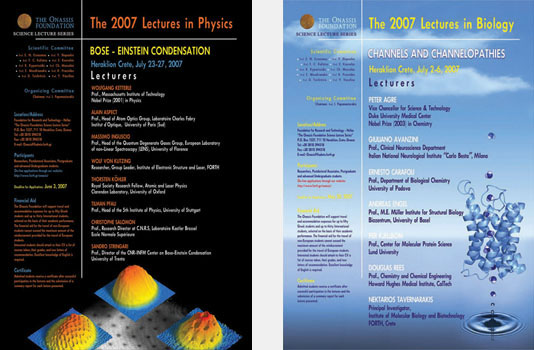
These advanced seminar lectures,
held for the seventh consecutive year with the
financial support of the Alexander S. Onassis Public
Benefit Foundation, are addressed to a small number
of international (post-graduate and advanced undergraduate)
students who are strictly selected on the basis
of their academic performance and receive a certificate
after successful participation in the lectures.
The
first lecture series, devoted to Biology, was held
over the period July 2-6, 2007, and was entitled
'Channels and Channelopathies'. The principal lecturer
was Professor Peter Agre, Nobel Laureate in Chemistry
(2003) and Vice Chancellor for Science and Technology
at the Duke University Medical Center, USA.
 |
 |
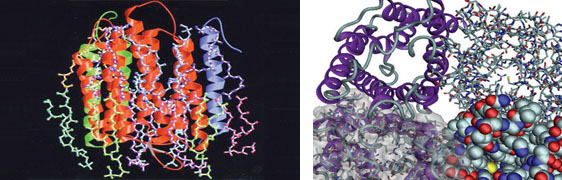
| Specific stereostructures, mainly proteins, function as channels and maintain the cell’s homeostatic optimum |
|
Every
cell is covered by a (mainly hydrophobic) biomembrane
that separates the intracellular and extracellular
environments, thus impeding mass exchange between
them. However, for the purposes of cellular metabolism
and communication between the different cells of
a tissue, but also between the different tissues,
a transmembrane transfer of mass (ions, sugars,
amino-acids, even water) is needed. This transfer
of mass has to overcome the problem of the hydrophobic
domain of the membrane interior, which means that
most of the molecules that must 'pass through'
the membrane are not soluble in it. Moreover, for
the cell to maintain its homeostatic optimum, this
transmembrane mass transfer needs to be specific
in chemical type and with well-controlled rates. Both
these problems are overcome thanks to the existence
and involvement of specific stereostructures (mainly
proteins) functioning as channels or pumps that
maintain the cell's homeostatic optimum. Any significant
divergence from this homeostatic balance causes
a metabolic malfunction often resulting in pathological
conditions or diseases.
In the 2007 Biology Lecture
Series, the speakers analyzed the main characteristics
of channels and pumps, and presented cases of diseases
(mostly human) resulting from their dis-regulation.
They presented representative examples found in
unicellular organisms, animals and plants, and
they focused, amongst others, on water, K+ and
Ca++ channels and pumps. Finally, they investigated
the role of channels and pumps in diseases of the
heart, the kidneys, etc.
|
 |
|
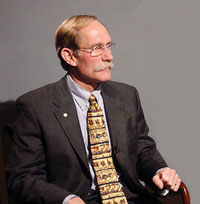
| Dr Peter Agre, Nobel Laureate in Chemistry 2003 |
|
Apart from Professor Peter
Agre, the following lecturers were invited: Guiliano
Avanzini, Professor, Clinical Neuroscience Department,
Italian National Neurological Institute “Carlo
Besta”, Milano; Ernesto Carafoli, Professor, Department
of Biological Chemistry, University of Padova;
Andreas Engel, Professor, M.E. Muller Institute
for Structural Biology, Biozentrum, University
of Basel; Per Kjellbom, Professor, Center for Molecular
Protein Science, Lund University; Douglas Rees,
Professor, Division of Chemistry and Chemical Engineering,
Howard Hughes Medical Institute, California Institute
of Technology; Nektarios Tavernarakis, Principal
Investigator, Institute of Molecular Biology and
Biotechnology, FORTH, Crete.
The second 2007 Onassis Lecture Series, devoted
to Physics, is entitled 'Bose-Einstein Condensation'
and will be held over the period July 23-27, 2007.
Bose-Einstein condensation is quite possibly one
of the most beautiful paradigms of the 'strangeness'
of quantum mechanics: millions of atoms lose their
individual identities and start behaving like a
single wave. This behavior had been
predicted by Albert Einstein already in 1924, on
the basis of Satyendranath Bose's work on photon
statistics: at extremely low temperatures, atoms
start condensing. Of course, at that time, Einstein
thought it impossible for experimentalists to ever
be able to reach low temperatures in the vicinity
of absolute zero, and, indeed, it took 70 years
for experimentalists to be able to demonstrate
this for the first time. In 1995, two American
research groups used lasers and magnets to cool
almost a million atoms to the lowest temperatures
that ever existed anywhere in the universe, and
saw for the first time a Bose-Einstein Condensate. This
brought the 2001 Nobel Prize in Physics to Professor
Wolfgang Ketterle of the Massachusetts Institute
of Technology, who will be the principal lecturer
in the 2007 Onassis Lectures in Physics.
 |
|
|
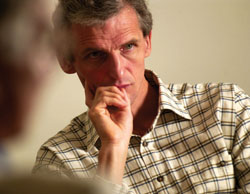
| Dr Wolfgang Ketterle Nobel Laureate in Physics 2001 |
|
Today,
Bose-Einstein Condensates are produced in over
sixty laboratories around the world. They are ideal
research tools to examine a wide range of problems,
such as superconductivity, superfluidity, solid
state phenomena, etc. A new generation of experiments,
one of which is being conducted at FORTH, uses
Bose-Einstein Condensates to create the most sensitive
accelerometers that have ever existed.
Apart from
Professor Wolfgang Ketterle, the following lecturers
are invited: Alain Aspect, Professor, Head of Atom
Optics Group, Laboratoire Charles Fabry, Institut
d'Optique, University of Paris (Sud); Massimo Inguscio,
Professor, Head of the Quantum Degenerate Gases
Group, European Laboratory for Non-Linear Spectroscopy
(LENS), University of Florence; Wolf von Klitzing,
Researcher and Group Leader, Institute of Electronic
Structure and Laser, FORTH; Thorsten Köhler, Royal
Society Research Fellow, Atomic and Laser Physics,
Clarendon Laboratory, University of Oxford; Tilman
Pfau, Professor, Head of the 5th Institute of Physics,
University of Stuttgart; Christophe Salomon, Research
Director at CNRS, Laboratoire Kastler-Brossel,
Ecole Normale Supérieure; Sandro Stringari, Professor,
Director of the CNR-INFM Research and Development
Center on Bose-Einstein Condensation, University
of Trento. |