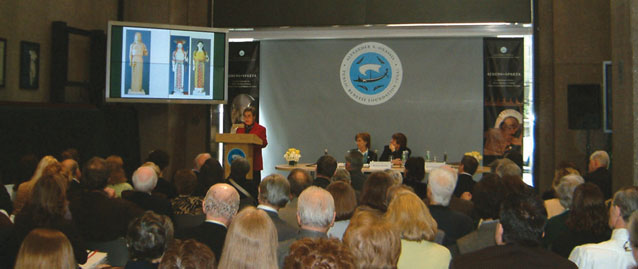
Over two hundred people attended
the conference, which brought together a large
number of speakers and scientists of world renown
from Greece and other countries. The audience consisted
of university professors, archaeologists, museum
directors, curators, and other members of the academic
world, who were specifically invited to the Onassis
Cultural Center from various American educational
institutions. The conference was opened by the
Executive Director of the Alexander S. Onassis
Public Benefit Foundation (USA), Ambassador Loucas
Tsilas, whose address was followed by an introductory
speech given by the Director of the National Archaeological
Museum of Greece, Dr. Nikolaos Kaltsas.
The opening lecture, given by Dr. Stavros Vlizos,
Archaeologist of the Benaki Museum, Athens, was
entitled, 'The Amyklaion Revisited: New Observations
on a Laconian Sanctuary of Apollo'. The sanctuary
of Apollo Amyklaios, along with the sanctuaries
of Athena Chalkioikos and Artemis Orthia, surpassed
the religious needs of ancient Sparta, expressing
both the everyday demands of social and political
life and the pressing tensions of the city's historical
existence. The sanctuary sustained its reputation
from the Late Bronze Age until the end of the Roman
Age, and the Lacedaemonians celebrated the annual
festival of the Hyacinthia there. In his lecture,
Stavros Vlizos briefly summarized the up-to-date
efforts made to locate and identify the sanctuary
of Apollo at Amyklai. Following a critical attestation
of Pausanias' detailed description [3. 18.9-19.5],
of the various mentions and interpretations by
travelers of the eighteenth and nineteenth centuries,
and, finally, of the results of the three excavation
campaigns in the late nineteenth and early twentieth
centuries, the speaker presented the conclusions
and new observations of a broader research project
that began in 2005.
 |
 |
|
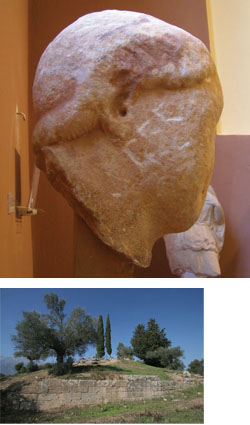
| Top: Head number 536 from Sparta Archaeological Museum was the subject of Dr. Georgia Kokkorou-Alevras' lecture
Bottom: Aghia Kyriaki hill and the sanctuary of Apollo Amyklaios from the lecture of Dr Stavros Vlizos |
|
Dr. Stella Raftopoulou, Archaeologist
of the Fifth Ephorate of Prehistoric and Classical
Antiquities, gave a lecture on the subject of 'Funerary
Banquets in Archaic Sparta'. The symposium is a
well-known Greek institution that bears religious
and social connotations. Spartan banquets became
famous because of their austere character, simple
food, and powerful political and military role.
Our imagination, said Dr. Raftopoulou, is captured
by depictions of symposiasts on Laconian cups,
posing the question of whether they illustrate
actual events that took place in Sparta. Archaeological
finds from the city, comprising a complete dinner
service with twenty-two intact vases, offer another
dimension to the textual and historiographical
tradition.
In an attempt to understand the function of this
service, Dr. Raftopoulou analyzed the various foods
and equipment that appeared at religious and military
meals, and questioned the actual use of each vase.
The banquet for which the particular service was
made was demonstrated to be among the textually
attested categories of political messes and religious
meals. It consisted of wine, soup (possibly the
'black broth'), small 'snacks,' vinegar and another
liquid (olive oil?), and up to four types of condiments.
It obviously took place in a tent or in the open
air near a cemetery. The exact occasion cannot
be determined. All the vases were dedicated near
the tomb, which may suggest a ritual dinner on
the occasion of either a burial or a commemorative
rite for an important family member, presumably
male, the heroized patriarch.
Exhibited in the Archaeological Museum of Sparta
is an overlifesize male head that is sometimes
referred to in the archaeological bibliography
as that of a kouros. Dr. Georgia Kokkorou-Alevras,
Professor of Classical Archaeology at the University
of Athens, spoke about this head. Known at least
since 1906, this very important head (Inv. No.
536) has never been properly published, although
it exhibits some interesting features concerning
its type, date, and style. According to Professor
Kokkorou-Alevras, the systematic examination of
all these parameters will throw new light on the
more or less obscure picture of Laconian sculpture
of the Late Archaic to Early Classical period.
The second part of the conference started with
the lecture 'Spartan Self-Presentation in the Panhellenic
Sanctuaries of the Classical Period' by Dr. Olga
Pallagia, Professor of Classical Archaeology at
the University of Athens. It is generally known
that art and architecture did not flourish in Sparta
and Laconia during the fifth and fourth centuries
BC. Spartan citizens were not encouraged to advertise
themselves by patronage of the arts or conspicuous
consumption. There is little evidence of portraits
of prominent Spartans at home in this period. The
Spartan elite, however, found an outlet for self-presentation
abroad, beginning with agonistic dedications in
Olympia. Between the conclusion of the Persian
Wars in 479 BC and the Battle of Chaironeia in
338 BC, a string of victories in the chariot races
in Olympia allowed the Spartan plutocrats who could
afford either to breed or maintain horses to erect
their portraits in the sanctuary. It was not customary
for Spartan kings to have their portraits erected
abroad. As Dr. Pallagia reminded her audience,
there is evidence of only two such portraits in
the Classical period, and both involve kings who
died while campaigning abroad. The young king Agesipolis,
who died in Aphytis in 380 BC, had his posthumous
portrait erected at Delphi privately by his father,
the old king Pausanias, who lived in exile at the
time. Moreover, the posthumous portrait of Archidamos
III was erected by the Spartan state in Olympia
after his death in Apulia in 338 BC. Pausanias
informs us that the Lacedaemonians set it up because
the king's body was never found for proper burial
in Sparta. Finally, Lysander, victor of the Peloponnesian
War, broke the mold by having his portraits erected
in both Olympia and Delphi during his lifetime
even though he was neither a king nor a victorious
athlete.
 |
|
|
| Dr Kurt Raaflaub in his talk analyzed the meaning of the term polis from Homer till Solon's time |
|
In her lecture 'Disiecta Membra: Early
Terracotta Images from the Athenian Acropolis',
Dr. Aliki Moustaka, Professor of Classical Archaeology
at the University of Thessaloniki, spoke about
the mostly unknown fragments of large-scale terracotta
figures found on the Athenian Acropolis. According
to Professor Moustaka, their special interest and
their probable significance for early cult activity
are based on their remarkable size, the peculiar
technique in at least one case, their richly decorated
garments, and their dating to the seventh century
BC. In spite of their state of preservation, they
can provide further indications about early cult
images on the Acropolis during a period that remains
scarcely known.
In his lecture
''Thalassa! Thalassa! The Spartans and …the Sea?',
Dr. Paul Cartledge, Professor of Greek History
at Cambridge University, developed the very original
subject of the Spartans' relationship with the
sea. The Spartans were the landlubbers of the ancient
Greek world. Their city lay inland, well away from
the coast, and they were the reigning military
force on the land, being the supreme exponents
of the hoplite style of warfare. Yet, according
to Professor Cartledge, there is also a history
to be written — and an interesting one — of Sparta's
dealings with, and deeds upon, the sea.
'Early
Hellenistic Sparta: Changing Modes of Interaction
with the Wider World' was the title of the lecture
given by Dr. Graham Shipley, Professor of Ancient
History at the University of Leicester. According
to Professor Shipley, the history of Sparta after
its defeat at Boeotian Leuctra (371 BC) tends to
be regarded as a story of terminal, and possibly
well-merited, decline. But this is to misrepresent
the subsequent two centuries and more of Sparta's
independent existence as a significant power in
the Peloponnese, and ignore the development of
a new urban form. How accurate is the perception
of Spartan weakness after the early fourth century
BC? In so far as that perception has any reality,
was external weakness mirrored by changes within
Sparta? How did internal dynamics change between
Leuctra and the radical reforms attempted by kings
Agis IV and Kleomenes III (in the third quarter
of the third century) and for what reasons?
|
 |
|
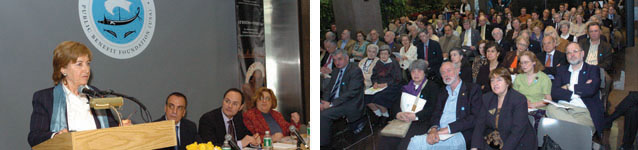
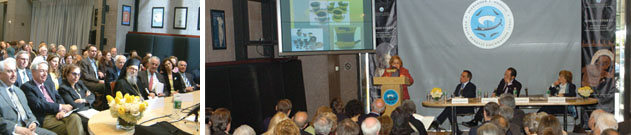
| Left: Dr. Georgia Kokkorou-Alevras, professor of Classical Archaeology at the University of Athens
Right: The international conference drew a large audience at the Onassis Foundation (USA) in New York |
|
According
to Professor Shipley, to understand Sparta during
this period, one must focus on both internal dynamics
and external links. The speaker suggested that
new economic and cultural interactions with the
wider Greek world, combined with a reduced capacity
to dominate directly the other communities of Laconia,
allowed the Spartans to exercise a more active
role in Greek affairs than is usually realized.
The
third part of the conference was completed with
the lecture 'Plutarch's Sparta: Lieux
de mémoire, trous de mémoire' given by Dr.
Richard J. A. Talbert, Kenan Professor of History
and Classics at the University of North Carolina,
Chapel Hill. Professor Talbert's lecture focused
on Classical Sparta and the paradox that, although
as a society Sparta was unconcerned with recording
itself or with projecting itself to others, it
came to exert a widespread fascination among contemporaries
that remains potent to this day. In consequence,
as the speaker pointed out —borrowing Pierre Nora's
pair of opposites—, the memory of Sparta has always
overshadowed its history.
|
 |
|
| Dr. Stella Raftopoulou spoke about the funerary banquets in Archaic Sparta |
|
No surviving ancient
writer has done more to shape that memory than
Plutarch. As an illustration of the multiple
ways in which this memory has influenced later
thinking, Professor Talbert drew attention to
an instructive yet seemingly overlooked instance
in late-eighteenth-century France. Attention was
also paid to those Lives of special relevance
to Sparta that Plutarch either intended to write
yet never did or which he did write but are now
lost. Finally, the speaker presented his thoughts
on how Plutarch was likely to have presented these Lives,
and how their completion and survival might have
altered posterity's memory of Sparta.
The final
part of the event, co-ordinated by Dr. Paul Cartledge,
started with the lecture 'Democracy and the Growth
of Athens' by Dr. Josiah Ober, Professor of Classics
and Political Science, Constantinos Mitsotakis
Chair in the School of Humanities and Sciences,
Stanford University, California. Professor Ober
suggested that, by quantifying newly available
information, it could be shown that Athens was,
according to various measures and over the course
of the Classical period, the most successful of
the Greek city-states. Athens was also highly democratic,
and the growth of democracy correlates with the
growth of Athens' capacity to do many things better
than its rivals. Athens was able to take advantage
of its great size and resources because 'democracy
as capacity to do things' addressed the serious
public action problems that beset all states.
|
 |
|
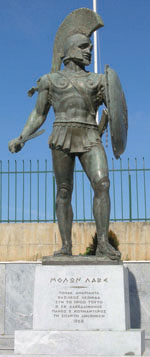
| Modern statue of Leonidas in Sparta |
|
The
Athenian solution resulted in a new approach to
organizing useful knowledge. Knowledge is possessed
by individuals and structured by institutional
rules; it potentially promotes both innovation
and learning. Finding the right balance between
individual agency and institutional rules, between
innovation and learning, is not easy. Yet, over
time, Athens found the right balance. It developed
efficient democratic processes to collect, co-ordinate,
and codify useful knowledge. As a result, Athens
addressed challenges of competition, scale, and
change better than even its greatest rivals: Sparta
and Syracuse.
The conference was concluded with
the lecture 'The Early Greek Polis: From Homer
to “Lycurgan” Sparta and “Solonian” Athens' given
by Dr. Kurt Raaflaub, David Herlihy University
Professor and Professor of Classics and History,
Program in Ancient Studies, Brown University, Rhode
Island. The term 'polis' is usually translated
as 'city-state'. In fact, according to the Greek
understanding, it was rather a citizen-state. What
mattered was the community of citizens rather than
the city as a place. The polis originated in the
mist of the late 'Dark Ages'. In Homer, it is already
a reality that is taken for granted: the heroes
define themselves according to their home polis,
and the main places of heroic action are poleis.
Remarkably,
the Homeric polis finds a stark contrast in the
small community of subsistence farmers represented
by Hesiod, who distances himself from the polis,
with its quarrels in the market place and corrupt
elite leaders. Less than a century later, in 'Lycurgan'
Sparta and 'Solonian' Athens, institutions begin
to be formalized, political processes defined,
and communal problems resolved by law and constitutional
reform. These two poleis move in different directions
and will soon shape themselves antithetically as
the ideals of a traditional aristocratic and a
revolutionary democratic polis.
|