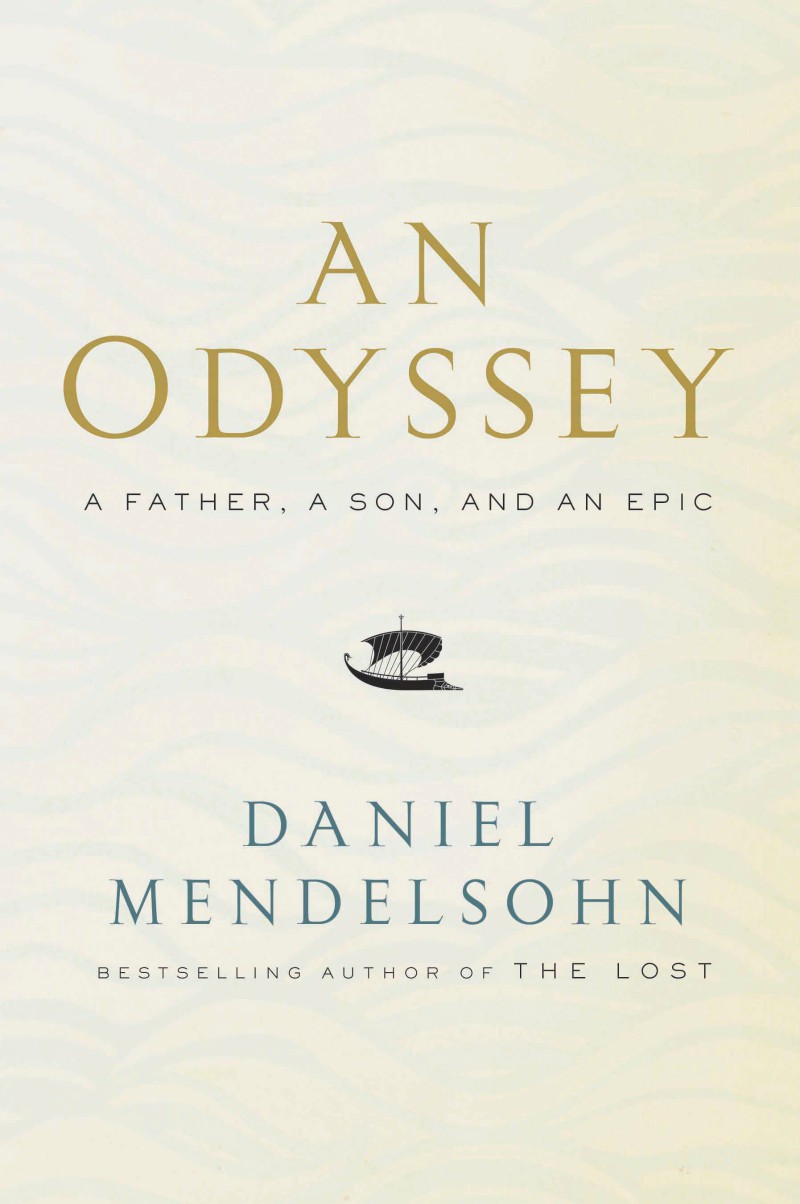


Daniel Mendelsohn's recent book An Odyssey: A Father, a Son, and an Epic, published in September 2017, tells a personal story by the prominent American writer, critic, columnist and classicist: his wanderings along with his father in university halls, cruises and hospital rooms, where son and father ultimately explore in depth the world of Homer and at the same time understand more about each other. Through clear parallels with the Homeric Odyssey, Mendelsohn juxtaposes two different worlds: the writer’s world of emotion, art and imagination with the world of logic and mathematics of his elderly scientist father. At the same time, he highlights the beauty of the Greek language and the splendour of the ancient epic poem.
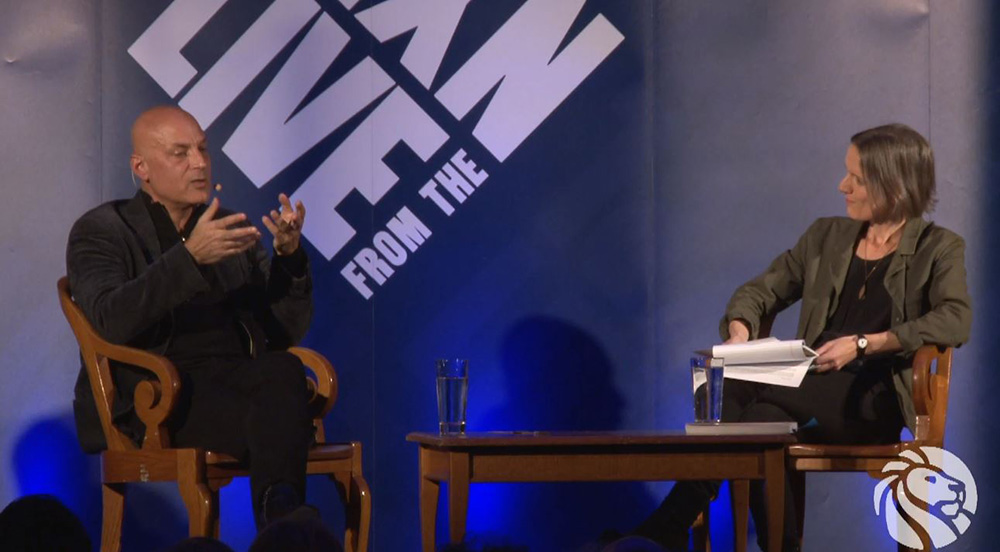
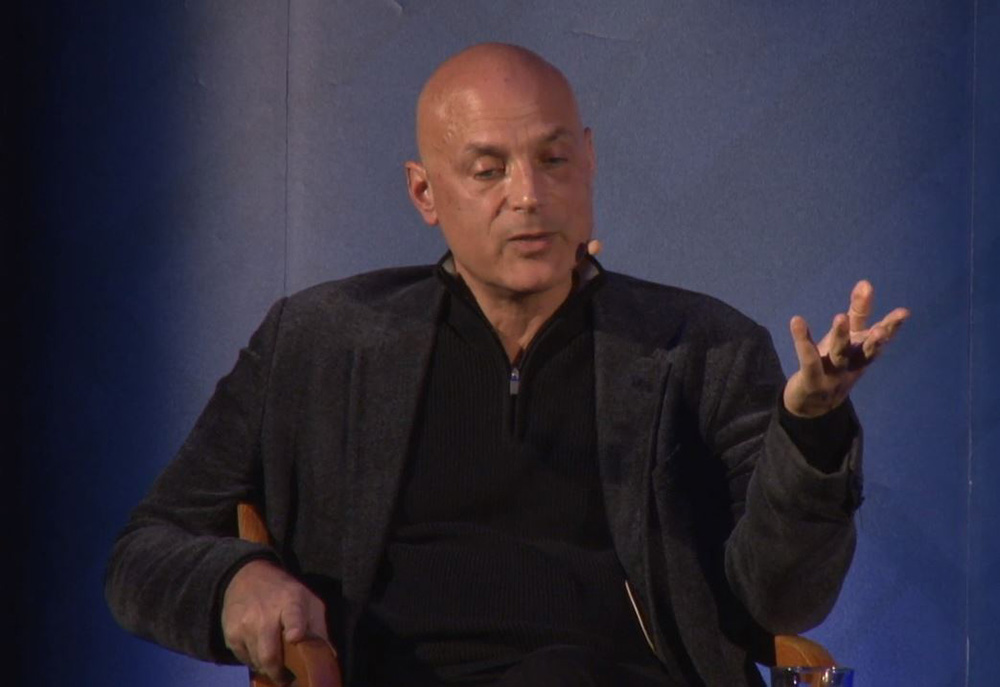
Invited by the Onassis Foundation USA, Daniel Mendelsohn talked about this book, the creative writing process and the joy of learning to New Yorker magazine journalist Rebecca Mead in a special event organized at the New York Public Library, in the cultural series LIVE from the NYPL, on November 16, 2017.
D.M.: The book is a memoir of what turned out to be the last year of my father’s life and there are three “Acts”. In January 2011, just before I started teaching at Bards College, my father announced he wanted to take my course. He was then aged 81 and I said “Yes”. Just as the semester was ending in May, my friend Froma Zeitlin said that she and her husband had gone on a cruise a few years earlier that recreated the voyage of Odysseus. So, we went on the cruise. Ten days, one for each year of the Odyssey. A couple of months after we returned my father tripped and fell and that was the beginning of the end of his life. He died a year after the course ended. Looking back at these experiences I realized there was a kind of narrative. The trick was figuring out the shape of the narrative, to map those elements of my story onto the plot of the Odyssey. I made a lot of mistakes until I began to think “Homerically”.
R.M.: What do you mean “to think Homerically”?
D.M.: Odyssey proceeds in a fashion that is anything but chronological; it’s constantly convoluting and doubling back on itself. It actually begins in the final year of Odysseus wanderings and then -through flash-backs, narratives and stories embedded within stories, in a very torturous way- you get the whole story, starting the day after the Fall of Troy. I had the manuscript of this book essentially finished in the summer of 2016, but it wasn’t working because I had everything lined up in the order I just told you (class-cruise-illness-death). There was no snap, no tension. After talking to people who were smarter than I am, I realized that there was something really wrong. Then, I had this sort of “light-bulb moment”, that I had to do this “Homerically” and embed some of these elements within others. In the book I talk a lot about this Homeric composition, ring composition, a very “oral” way of narrating. Once I did that, I finished the book in two months.
R.M.: You suggest from the very first sentence of the book that you’re linking together the present and the past…
D.M.: I had to respond to a questionnaire and one of the questions was: “Do you sometimes turn to fiction as a relief from the rigors of research in non-fiction?” and I just thought “Really?”. Non-fiction is more than journalism and writing book reports. Many people think when writing a memoire or a “memoiristic” narrative how to construct it so it’s as interesting as any novel would be. One of the challenges of writing non-fiction memoires is to create narrative tension, to plant the seeds in Act I that are going to blossom in Act V. It’s exactly what novelists do. Non-fiction is not just a transcription of things that happened; it hopefully is as artful as anything else. My father built beds for me and my older brother when we were growing up in the suburbs of Long Island. If you have read the Odyssey, you know that the whole climax of the Odyssey has to do with a secret about the construction of a bed that Odysseus has built for Penelope. I wanted to think of a way to use this bed in a way that would also have a climactic importance in the story of me and my father. It’s a matter of construction. As a critic I’ve always been especially interested in structure and how things work. I think good narratives are like little Faberge eggs: they have these great mechanisms inside.
R.M.: Do you draw out a structure? Do you write the structure? Or you just hold it in your head?
D.M.: Yes, basically. I don’t make outlines, I don’t list my themes, I don’t do any of the things I tell my students! When you are working on something for a long time, there is a moment when it’s fully in your head. It doesn’t last, but when it’s happening you know exactly where all the pieces are. It’s a product of a kind of creative consciousness that you enter into when you ‘re working on a big project and it’s all in your head.
R.M.: In this year-long journey you went on with your father, at what point did you realize that you had a book?
D.M.: I would say on the cruise. At the beginning -when my father called and said “Can I sit at your freshmen course?”- I thought this was going to be an amusing personal history piece for the New Yorker, particularly when the course began to unfold. There was from the beginning a comic element, because it turned out that my father hated the Odyssey and completely disapproved of Odysseus. This becomes a kind of running joke around the course and throughout the book. It was too good to be true. There were also many moving moments in the classroom, because the Odyssey brought out this kind of resistance in my dad. I should say my father was a mathematician, a research scientist in the Aerospace Corporation, and he just didn’t understand why anyone was supposed to think that Odysseus was so great. Anyone who has been on a reading class knows what this is like. Peoples’ comments about the books say much more about them than they say about the books.
On the cruise, so many amazing things happened. In the Odyssey, there are many great moments that combine all of its themes of memory and pain, suffering and recognition. It’s this scene were Odysseus has returned home, he is in disguise, he gets a bath in his own palace from an elderly nurse who recognizes on his thigh a deep scar that he got when he was a teenager. So, I am on the cruise and there was a European lady about my age traveling with her elderly father. She knew who I was, she had read one of my books on the Holocaust [The Lost: A Search for Six of Six Million (2006)] and she said: “You know, my dad wants to talk to you, because he had a very interesting experience during the war that he wanted to share with you”. I said: “Great, where is he?”. She said he was on the sun-deck by the pool. “You can’t miss him, he’s got a huge scar!” she said, and I burst out laughing and I said: “You’re kidding!” and I thought “OK! I’ve got to write a book!”. As I always say, I don’t even know why anyone writes fiction…You just turn around and there are such amazing stories…
R.N.: One doesn’t know if it’s inspiration or psychosis …
D.M.: They often go hand-in-hand. When you’re “in the zone” and you’re thinking about your text, everything starts being radiated. That’s why editors are for; because sometimes “a cigar is just a cigar”. [A sentence attributed to S.Freud suggesting that not all of our actions are the result of subconscious desires].
R.M.: This is a book written in mid-life about understanding the Odyssey in mid-life. But I want to go back to your earliest encounters with the Odyssey as a young man, as a teenager. In what way did it speak to you differently then?
D.M.: It’s funny how it’s all tied with my dad. I remember very vividly my parents had a cocktail party about 1974, my dad and one of his buddies from work and his wife who was an English teacher. We were allowed to go down for a few minutes to say hello to the guests. I was 14 and I was interested in mythology, and she said: “You should read the Odyssey -not the Iliad, it’s too much for you- the Odyssey you ‘ll love, it has got great adventures.” Many young people love it as it is a kind of proto-science-fiction narrative, it’s like Lost in Space. So, I did connect to it that way. The Odyssey is an electrifying narrative. A good book is a book you think about differently as you get older (which I don’t think is the case with A Catcher in the Rye…). A great text can accommodate many revisions, so you start noticing different things as you get older. You, as a reader, are a moving target. So much of the Odyssey is about aging and whether you are the same person as you age. That’s the whole climax of the Odyssey: can these two people, that have been separated for 20 years, still know each other? It’s a meta-literary concern: Are you the same self who read the Odyssey? The answer is “No”. So, one of the things I see now, that I never could possibly have seen when I was 14, is how much it is about family and how wise it is about families. This is a story about a man in middle age who is trying to recognize his family again and be recognized by his family. That aspect of it struck me with an obvious kind of force when I was reading it in my early fifties. But having my father sitting there in the classroom, it brought home so much about the Odyssey.
R.M.: Because you were playing out the family recognition in the classroom…
D.M.: Yes, and learning about my dad. We were close with my father, this is not a book about a sudden closening between a strange father and son; we had traveled together, but there were so many things that I learned. The Odyssey is particularly interested in fathers and sons. Like all patriarchal societies, the Greeks were obsessed with this question of fathers and sons. People say the Odyssey is projecting the anxiety of Greek men. Few sons are as equal to their fathers, most are worse. So, I started with the Odyssey as an amazing adventure story with many more levels than a 14-year old can appreciate, but I end as seeing it as a very great poem about family life and its strangeness. Among other things, how little children understand about their parents’ marriage. There were things that emerged during the three months of my father’s illness that I never imagined. It brought to the fore what I think were very Odyssean questions: How can you be drastically changed and still remain yourself?
R.M.: At the beginning of the book you describe your own father’s visits to his father as he was dying. And you, as a young man, couldn’t understand why your dad went every lunchtime to sit with his father who was no longer capable of recognizing him. And you father said…
D.M.: “Your father is your father.” My father had a very rigorous mind (“x is x and nothing else”). He was a mathematician. That was his main objection to pop music we listened to, he was very interested in the lyrics, but he only liked strict rime. He would say “A rime is a rime, you can’t fake it”. So “Your father is your father.”
R.M.: A lot of people would ask what do you think your father would have made of the book. But what I’m more interested in is the question “What do you feel you’ve made of your dad?”
D.M.: It’s an interesting and difficult question. One stops being able to know whether we inhabit the text or the texts inhabit us and you start living almost through the text, filtering your own experiences through the text, making people into characters, possibly unconsciously. There is no question I am mythologizing my father and I do it very consciously in the book, but it’s a little uncomfortable because I have four siblings, all are very smart, a couple of them very good writers, and they could write their own books about my father which would be very different. So of course, to the purposes of my narrative (and one does this in non-fiction), I don’t think that the character who appears in this book is wholly equal to the man who was my father; it represents parts of him.
R.M.: The book is so much about education too, the joy of learning. I particularly enjoyed the way you talk about the richness of the Greek language. There is a sentence: “What thrilled me about the Greek shifting tenses were these fantastically metastasizing verb tenses, the shifts in time signaled by prefixes that agglomerated like crystals, by endings that pulled at the ends of words like honey that has tripped off the end of a spoon into a saucer” which is so beautiful and makes me very sorry that I never learned Greek. The pleasure that you take in the texture of language is something I want to ask you about and the way in which, with your knowledge of Greek and Latin, you have this depth of understanding into the words we use in English.
D.M.: When you are a classicist it’s like you see ghosts in the house all the time. I “see” dead languages… Every word is a palimpsest if you know the classical languages and it’s so exciting and it colours your senses of different words. You can’t write a book about the Odyssey without showing people why this language is so amazing. There is a part I talk about Greek verbs. When I was learning Greek, as a first-year student at the University, we used this skinny Introduction to Greek by Chase and Philipps. The practice verb that they used to demonstrate all the forms of a regular Greek verb is the verb to educate -παιδεύω. In ancient Greek you can express the concept of ‘the person who is about to educate’ with one word (παιδεύσων) and I thought “I want to be on that team”. In an era when there is a lot of casualness about language I thought it was good to go back. Ιt’s part of the pleasure of being a philologist in any language: the rigor, the structure and the almost mathematical beauty of grammar. It’s not an accident that my father approved of me doing a PhD in Classics because he admired the rigor of Greek which to him was like a mathematical paradigm: it is regular, it imposed some kind of order on things. And that made sense to him.
One of the things I learned about my father was that he was given all kinds of opportunities that for reasons of his personality he never thought he could seize. It’s a thing that I love about this book that everyone loves, Stoner [John Williams, 1965]. I don’t think it’s a book about this man who so wonderfully transcends the limitations of his rather small life. I think it gets in an even more profound way about the way our origins to some extent establish the expanse of how we can live. And that was true of my father; he went much further than his parents did -which is the great American dream of course- but he couldn’t go too much further ultimately. That explains why he pushed us so hard to succeed in school and academic excellence. This retroactively gives me great sympathy for him and understanding.
You can follow the podcast here: https://livestream.com/nypl/events/7645296